

t is amazing how often standard Department of Transportation (DOT) regulations are misunderstood or underutilized in the transportation industry. It’s a bit like a famous Bible verse that everyone quotes, but only a few have actually sat down to read for themselves! 📖
Whether due to sheer oversight or simply following industry habits that don’t play by the rules, many employers, Designated Employer Representatives (DERs), drivers, and testing sites fall into common compliance traps.
Let’s break down 4 critical “hot topic” DOT rules that every Substance Abuse Professional (SAP), employer, driver, testing site, and C/TPA needs to get right.
Table of Contents
Toggle1. 📩 Reporting Follow-Up Testing Plans Directly to the DER
One of the most frequent missteps in the industry occurs when requesting or sending follow-up testing plans.
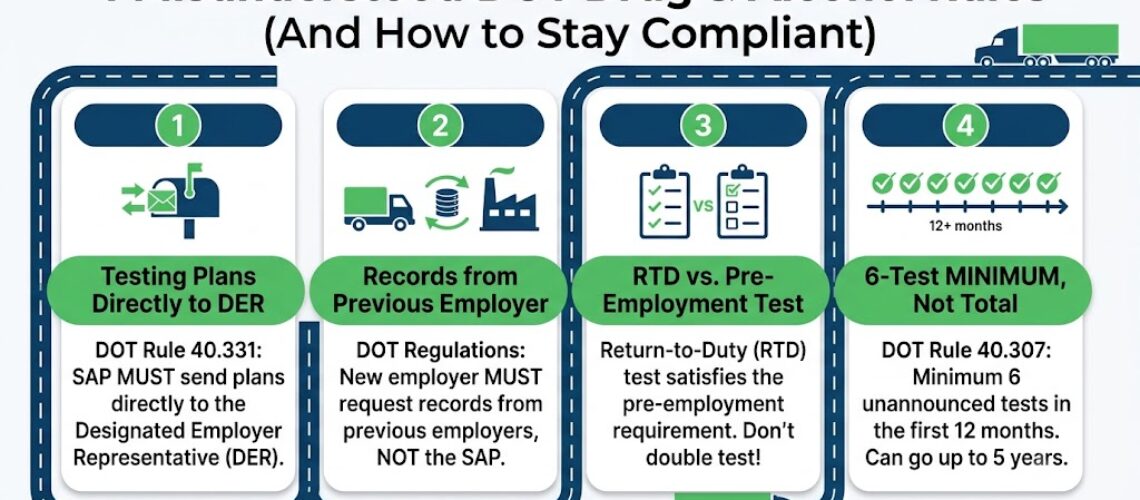
As explicitly outlined in DOT Rule 40.331 Guidelines, the SAP must send written evaluation reports and follow-up testing plans directly to the Designated Employer Representative (DER)—not to an unverified third party, secretary, safety team, or HR department without identifying who the actual DER is.
⚠️ The Fix: Anyone requesting a follow-up testing plan from a SAP must clearly disclose the designated DER’s first and last name, phone number, and email address. A C/TPA or administrative team member can receive copies simultaneously, but the DER must always be identified and directly included.
2. 🔄 Driver Changing Employers? Request Records from the Previous Employer, Not the SAP
When a driver moves to a new company, many onboarding teams automatically reach out to the driver’s SAP to request testing plans and historical reports, bypassing the previous employer. This is a major compliance no-no! 🚫
Under DOT regulations, the new employer must request the driver’s SAP evaluation reports, follow-up testing plan, and all completed negative follow-up test results directly from the previous employer(s)—not from the SAP.
Why does this matter?
Conducting thorough due diligence with previous employers isn’t just a regulatory requirement; it’s a vital safety net. It allows the new employer to vet the driver’s full compliance history, verify past tests, and seamlessly continue the testing schedule right where the previous employer left off.
Want to dive deeper into this rule? Read our detailed guide on DOT follow-up testing when changing employers.
3. 🧪 Return-to-Duty (RTD) vs. Pre-Employment Testing
When an employee is cleared by a SAP to return to safety-sensitive duties, what test should they take?
According to FMCSA Return-to-Duty Guidelines, a Return-to-Duty (RTD) test satisfies the pre-employment testing requirement. Employers do not need to send the driver for two separate tests!
💡 Key Difference to Remember:
- Pre-Employment Test: Standard unobserved test. Does not clear a driver’s violation status in the FMCSA Clearinghouse.
- Return-to-Duty Test: Directly observed test. This is the only test type that removes the prohibited status and updates Step 5 in the Clearinghouse.
4. 📅 The “6-Test Rule” is a MINIMUM, Not a Cap
A common myth among drivers (and even some employers) is that a follow-up plan requires only 6 tests total and then it’s finished.
Under DOT Rule 40.307, the SAP must mandate a minimum of 6 unannounced follow-up tests in the first 12 months post-hire/return. However:
- The SAP may require 7, 8, or more tests in year one.
- Follow-up testing plans can extend for up to 5 years (60 months).
- Neither the SAP nor the employer can disclose the total number of tests or exact timeline to the employee with a violation.
The plan officially concludes only when the driver receives their 6th Step Checkmark in the Clearinghouse. 🏁
💡 The Bottom Line
Compliance isn’t about guesswork—it’s about opening up the rulebook and following established regulations. Whether you’re a driver, employer, testing site, C/TPA, or DER, understanding these rules protects your business, your commercial license, and public safety. Let’s get more efficient and play by the rules!
Need answers to your question, guidance to the DOT Rules, or in need of a SAP Evaluation?
We got your back!📞 Call now: 916-399-3047