
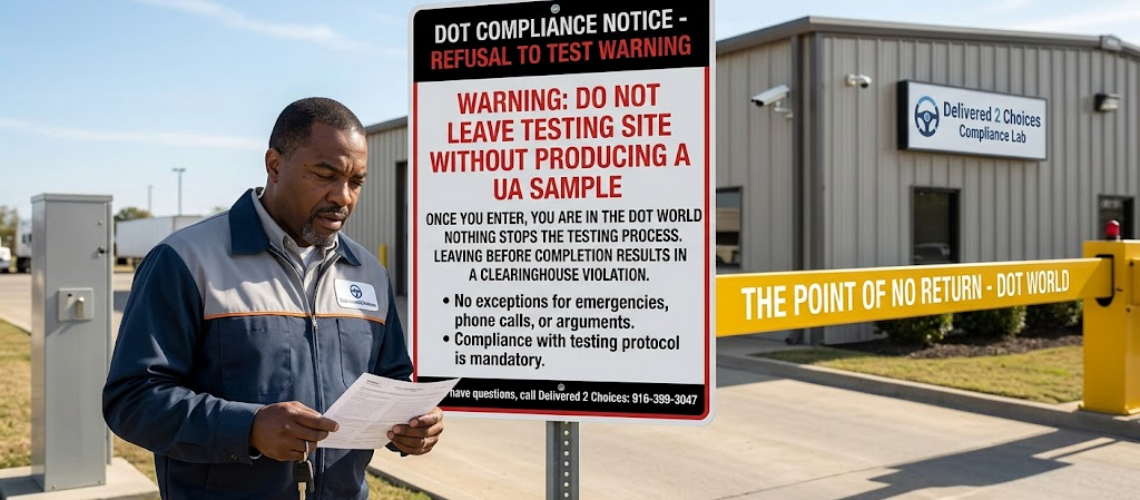

Right now, “Refusal to Test” violations are a massive trending topic in the DOT and FMCSA world. In fact, many drivers end up with a Clearinghouse violation without ever failing a drug test simply because they did not understand the strict rules. If you currently have a refusal to test violation and want to clear it up, call us now at 916-399-3047 to start the SAP portion of the Return-to-Duty process.
Table of Contents
ToggleCommon Reasons for a Refusal to Test
A refusal is not always a direct “no” to taking a test. Instead, there are several different scenarios that the DOT automatically classifies as a refusal. For example, a refusal can occur if you:
- Fail to show up: Missing a random test entirely.
- Leave the testing site for any reason: This includes leaving for a family emergency, stepping out to take a phone call, going outside to smoke a cigarette, or grabbing something from your car.
- Choose not to test: Deciding not to test because you think you might test positive for a drug like marijuana.
- Argue with the technician: Getting upset with the test site technician for any reason or getting into an argument with them. Ultimately, the best thing to do is comply with the testing protocol, or your actions will be deemed a refusal to test.
- Provide a suspicious sample: If your urine sample has a suspicious smell, discoloration, or temperature, the collector may change your random test into an observed test. Consequently, if you feel this is intrusive and refuse to test in front of someone, it becomes a refusal.
- Run out of time: Arriving at the clinic right before closing and being unable to produce a specimen (often called “shy bladder”). Because you didn’t have time to drink water and try again, it will be deemed a refusal.
The “Point of No Return” Rule
Most drivers do not realize that once you step inside the testing site for a random, pre-employment, or any DOT test, you enter the DOT world. At this point, nothing will stop the testing process from moving forward.
For instance, imagine you are waiting to get tested and you receive a phone call about a family emergency. You might need to pick up your kids or maybe you suddenly get sick. Even if you call your boss and they say, “Go ahead and leave, just go back tomorrow,” they are giving you bad advice. Unfortunately, leaving will still generate a refusal to test. Your company cannot save you from needing to take that test once you have arrived. Bottom line: never leave the testing site without producing a UA specimen, or it will be deemed a refusal to test.
Which Tests Can Spark a Violation?
Some people do not realize what types of tests qualify as a DOT test. For some reason, a common myth is that pre-employment tests do not count. However, they absolutely do.
According to federal rules, there are specific types of tests that can spark a violation. You can find these rules clearly outlined on pages 4 and 5 of the official DOT Employee Handbook. The rule clearly points out that all six of these tests are subject to violations:
- Pre-employment
- Reasonable Suspicion/Cause
- Random
- Return-to-Duty
- Follow-up
- Post-Accident
Therefore, be extremely mindful anytime you are sent in for drug testing.
Clear Your Violation Today
Have a refusal to test violation and want to clear it up? At Delivered 2 Choices, we can help you navigate this stressful situation in a timely, judgment-free manner. Call us right now to start the SAP portion of the Return-to-Duty process and get back to work!