
DOT Qualified SAP Evaluation in California
What is a DOT SAP Evaluation and Why Do You Need It?
The Substance Abuse Professional (SAP) at Delivered 2 Choices is a neutral evaluator prioritizing public safety, rather than an advocate for the driver or the employer. A DOT SAP evaluation is the only legally accepted pathway to regain a commercial driver’s license (CDL) after a violation is recorded in the FMCSA Clearinghouse. Any driver who received a violation such as a failure to test or a positive drug test must complete the SAP portion of the RTD process to get back behind the wheel of a semi-truck or large heavy equipment.
The Clearinghouse rules escalated significantly in November 2024, when state licensing agencies were required to act on Clearinghouse data and downgrade CDLs for drivers in a “prohibited” status. See the DOT SAP Evaluation purpose at this DOT official website.
The Complete FMCSA Clearinghouse Return-to-Duty Process
Navigating the Federal Motor Carrier Safety Administration (FMCSA) requirements requires a strict, sequential workflow.
Step 1: Clearinghouse Registration and SAP Designation
Before your evaluation can begin, you must log into the FMCSA Clearinghouse portal and officially designate Delivered 2 Choices as your chosen Substance Abuse Professional. This connects our evaluation directly to your federal record.
Step 2: The Initial Clinical Assessment
You will undergo a comprehensive, 100% virtual video session. During this face-to-face virtual assessment, the SAP gathers your clinical history, violation details, and substance use background to determine the appropriate next steps.
Step 3: Education and Treatment Recommendations
Following the initial assessment, the SAP provides mandatory education or treatment recommendations. These requirements are mapped directly to the severity of your violation and are a federal requirement under 49 CFR Part 40; you must complete them to proceed.
Step 4: The Follow-Up SAP Evaluation
Once you have completed the prescribed program, you will attend a follow-up evaluation. This session confirms your compliance with the initial recommendations, allowing Delivered 2 Choices to update your FMCSA Clearinghouse status with a “Determination of Eligibility” date.
Step 5: The Employer's Return-to-Duty Test
After receiving your eligibility date, your employer or your Consortium/Third-Party Administrator (C/TPA) must order and conduct a final return-to-duty drug and/or alcohol screen. The SAP does not conduct this test.
Step 6: The Follow-Up Testing Plan
Upon successfully returning to duty, you are subject to a federally mandated follow-up testing plan. The FMCSA requires a minimum of 6 unannounced, observed tests over the first 12 months, though the plan can legally extend for up to 60 months.
Common Violations That Trigger the SAP Process in California
Any recorded violation immediately suspends your safety-sensitive functions. The most frequent Clearinghouse triggers include:
Positive Marijuana Tests: First, Despite California state laws legalizing recreational and medical cannabis, federal DOT regulations strictly ban any THC presence in a commercial driver’s system.
Positive Alcohol Tests: Additionally, Registering a blood alcohol concentration (BAC) of 0.04 or greater while on duty, or testing positive for alcohol within four hours before reporting for duty.
Refusals to Test: Furthermore, Declining to take a mandated drug or alcohol test carries the exact same federal penalty as a positive test result.
Adulterated or Substituted Specimens: Attempting to alter or fake a urine sample immediately triggers a Clearinghouse violation.
Understanding Your SAP Evaluation Costs & Pricing Transparency
Unlike programs that hide their fees or charge you per phone call, we keep it simple with a $450 flat fee upfront.
This comprehensive cost covers:
The initial clinical assessment.
Program mapping and treatment recommendations.
The final follow-up evaluation.
Marijuana levels monitoring to ensure your THC metabolites fall completely below the strict DOT cutoff level of 15 ng/mL prior to your return-to-duty test.
All mandatory reporting to the FMCSA Clearinghouse.
We do not charge hidden administrative fees for follow-up sessions or paperwork processing.
Glossary of Key FMCSA Terms
C/TPA (Consortium/Third-Party Administrator): A service agent that manages drug and alcohol testing programs for employers, often handling return-to-duty testing and random testing pools.
MRO (Medical Review Officer): A licensed physician responsible for receiving and reviewing laboratory results generated by an employer’s drug testing program.
DER (Designated Employer Representative): An employee authorized by the employer to take immediate action to remove employees from safety-sensitive duties and make required decisions in the testing and evaluation processes.
RTD (Return-to-Duty): The federally mandated process and final required drug/alcohol test a driver must pass before resuming commercial driving operations.
Frequently Asked Questions
Will I be able to work while going through the Return-to- Duty process with a Substance Abuse Professional (SAP)?
You are NOT permitted to perform DOT safety-sensitive functions while going through the Return-to-Duty process with a SAP. However, you may work in a non- safety-sensitive position at the discretion of your employer.
Who is required to go through the DOT Return-to- Duty Process with a SAP?
All DOT-regulated safety-sensitive employees/candidates in the aviation, railroad, public transit, trucking, maritime, and pipeline industries who violated the federal DOT drug and alcohol testing rules. (e.g., positive drug test, refusals,or self-referrals)
How long will the entire Return-to-Duty process take?
The time it takes to complete the DOT Return-to-Duty process varies. Based on the assessment outcome, severity of drug/alcohol use, the timeline could be a few days (LOW severity) to a few months (HIGH severity). The SAP must make a recommendation for some level of care per DOT CFR 49 Part 40 Subpart O.
I was terminated after a violation. Do I still need to go through the Return-to-Duty process?
Yes, Once you have violated the federal drug and alcohol testing regulations, you are prohibited from preforming safety-sensitive functions for any DOT regulated employer and must complete the Return-to-Duty process with a SAP.
If I test positive on a DOT Drug or Alcohol test, can’t I just retake the test?
No, this is why a split sample is collected. Only the other half of the sample collection can be re-tested. You still must be removed from safety-sensitive functions until you complete the Return-to-Duty process.
Is Return to Duty and Follow-Up testing required?
Yes, you must test negative on a Return-to-Duty Drug, Alcohol test (or both) before returning to DOT safety-sensitive functions. You are also subject to unannounced follow-up testing for at least 1 year, up to 5 years, determined by the SAP. The follow-up testing plan is provided directly to your employer/DER.
California Cannabis Laws
California state law legalized recreational and medicinal marijuana. The state even passed employment protections under AB 2188. However, federal regulations completely override these state laws for commercial drivers.
Zero-Tolerance Federal Mandate: The Department of Transportation (DOT) operates under strict federal guidelines. Any detectable THC metabolite triggers an immediate violation. Off-duty consumption does not matter.
No Exception for Off-Duty Use: California laws protect workers from discrimination based on off-duty cannabis use. These state laws explicitly exclude employees in safety-sensitive DOT roles.
Automatic CDL Downgrade: A positive marijuana test reported to the FMCSA Clearinghouse prompts the California DMV to downgrade your Commercial Driver’s License. This downgrade lasts until you complete the full Return-to-Duty process, up to completing step 5.
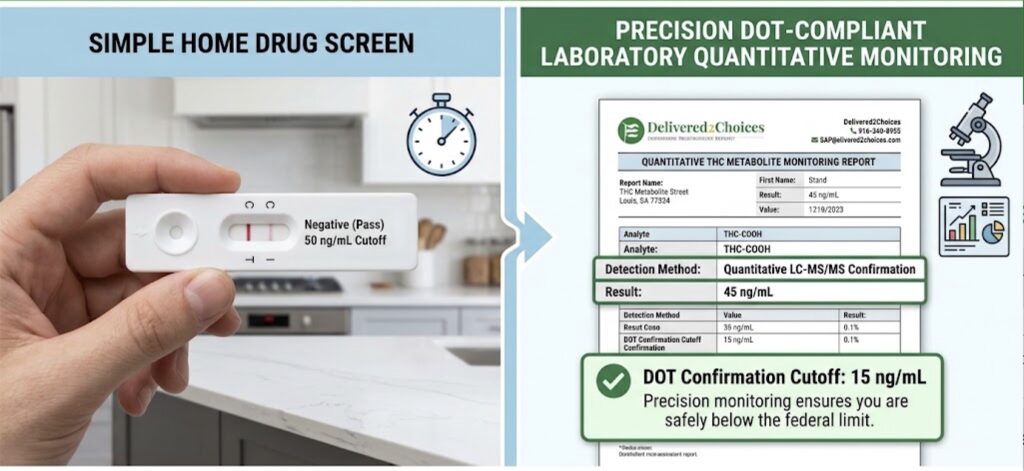
15 ng/mL THC Monitoring
Standard store-bought drug tests only check for a high threshold of 50 ng/mL. Relying on these basic tests often causes drivers to fail their official return-to-duty test. We remove the guesswork by tracking your exact metabolite levels.
Step 1: Baseline Quantitative Testing: We send you to an accredited laboratory for your initial test. This provides an exact THC metabolite concentration. You get a precise starting number rather than a generic pass/fail result.
Step 2: Biological Clearance Tracking: THC metabolites store in body fat and release slowly. Metabolite concentrations in heavy users generally cut in half roughly every 10 days. We map your elimination curve to estimate your clearance timeline.
Step 3: Quantitative Reporting: Standard panel screens report a binary “Negative” once levels drop below cutoff. However, any sample above 15 ng/mL triggers a confirmation test reporting your exact numeric level.
Step 4: Risk-Free Scheduling: Delivered 2 Choices approves your eligibility date only after lab data proves your system is clear. This ensures total confidence before your official test.
Education vs. Treatment

The DOT requires a specific plan for every driver. A SAP evaluation does not offer a one-size-fits-all solution. Your evaluator must recommend either education or treatment based on your initial clinical assessment.
-
The Education Pathway: We recommend this route for isolated incidents or first-time offenders showing no signs of substance use disorder. This involves a DOT-approved educational course ranging from 4 to 20 hours. The SAP determines the exact length based on specific case details, such as accidental ingestion. You learn about the safety risks of drug and alcohol use in the transportation industry through vetted online education courses.
-
The Treatment Pathway: We recommend outpatient or inpatient treatment for drivers exhibiting patterns of chronic use or addiction. This involves structured clinical therapy. The DOT requires you to successfully complete this program before you can take your return-to-duty test.
-
The SAP’s Final Word: You cannot choose your pathway. Federal law dictates that the SAP determines the required level of care. You must follow the exact recommendation to regain your commercial driving privileges.
The Direct Observation Rule: What to Expect at the Clinic
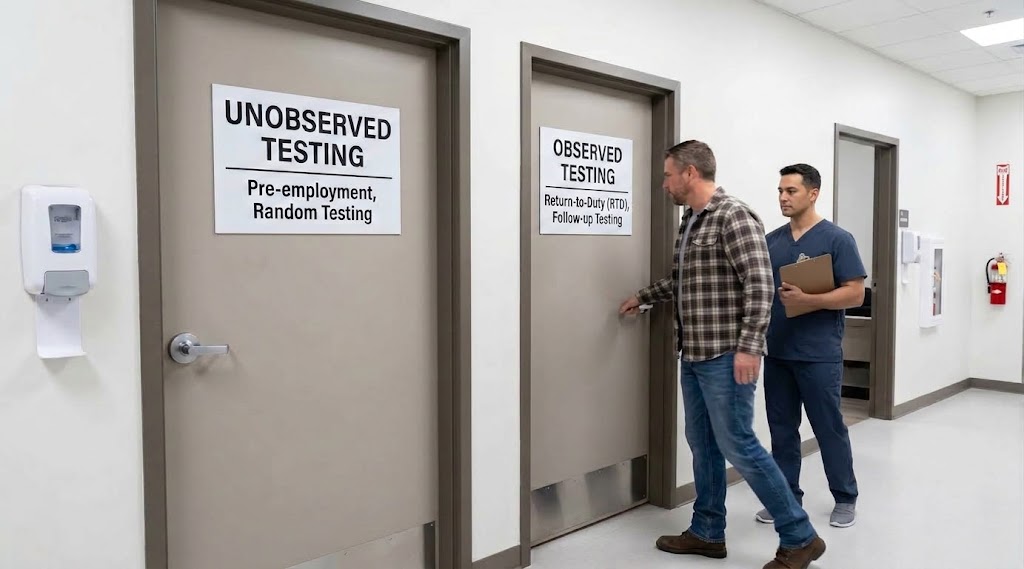
Drivers are often caught off guard by the strict difference between standard drug screens and the FMCSA Return-to-Duty process. Under 49 CFR Part 40.67, the DOT legally mandates that all Return-to-Duty and Follow-Up tests must be collected under direct observation.
Observed vs. Unobserved Testing: While standard pre-employment and random drug tests allow for privacy behind a closed door, Return-to-Duty and Follow-Up tests strictly prohibit using a private stall to prevent specimen tampering.
Same-Gender Observer: The clinic will assign an observer of the exact same gender as you. They will follow you into the designated observation room to conduct the testing procedure.
The Anti-Tampering Inspection: Before providing the sample, the observer will require you to raise your shirt above your navel and lower your pants to mid-thigh. You must turn around to prove you are not hiding any prosthetic devices or clean urine substitutes.
Direct Visual Monitoring: The same-gender observer must physically watch the urine leave your body and enter the collection cup.
Refusal to Comply: If you argue, refuse to adjust your clothing, or refuse the observed collection, the clinic immediately reports it to your employer as a “Refusal to Test.” The FMCSA logs this as a brand new violation in the Clearinghouse, stripping your driving privileges and forcing you to start the SAP process completely over from Day 1.
Owner-Operators & Employees: Navigating C/TPA Requirements
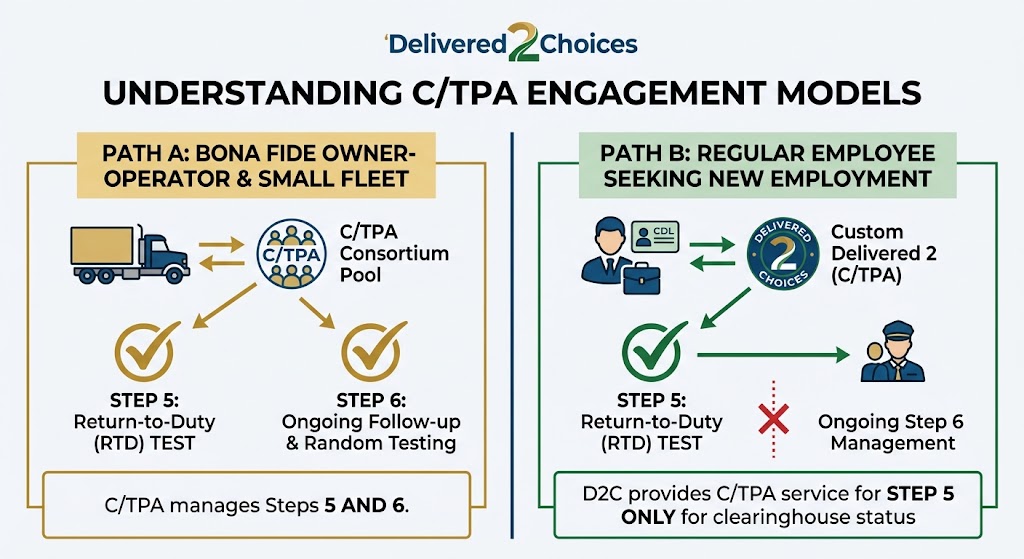
Navigating the Return-to-Duty process looks very different depending on whether you operate your own fleet or are an individual employee seeking CDL reinstatement.
Path A: Bona Fide Owner-Operators & Small Fleets Federal law requires all single-driver CDL holders to operate under a Consortium/Third-Party Administrator (C/TPA). You act as both employer and employee in the FMCSA Clearinghouse. Therefore, your designated C/TPA must manage your official Step 5 Return-to-Duty test and your ongoing Step 6 random follow-up testing plan.
Path B: Individual Drivers, DMV Reinstatement & Job Readiness Completing Step 4 gives you a “Determination of Eligibility,” but it does not guarantee a job. Many motor carriers will not hire drivers with recent violations due to strict company policies or commercial insurance liability restrictions.
State driver licensing agencies must downgrade commercial driving privileges for anyone with a prohibited status. Consequently, this is strictly enforced under FMCSA Clearinghouse CDL Downgrade rules. Fortunately, you can register in the Clearinghouse as an Owner-Operator for the sole purpose of designating Delivered 2 Choices as your C/TPA for Step 5:
Overcome Hiring Roadblocks: Completing your Step 5 RTD test through Delivered 2 Choices removes the requirement for a prospective employer to order or sponsor your return-to-duty test.
Immediate CDL Reinstatement: Getting your 5th checkmark in the Clearinghouse prompts the California DMV to lift your “prohibited” status and reinstate your commercial driving privileges.
License Renewal Protection: If your CDL is due for renewal, the DMV blocks renewal until Step 5 is complete. Achieving the 5th checkmark clears the path to renew your license on time.
Complete Step 6 Onboarding: Once you pass your Step 5 test through our C/TPA services, your federal record reflects an active, clear status. When a company does hire you, responsibility for Step 6 (ongoing follow-up testing) transfers smoothly to that employer.
Get Back Behind the Wheel: Timely FMCSA Return-to-Duty Completion

Every day your CDL remains in a “prohibited” status is a day of lost income. At Delivered 2 Choices, we streamline your entire SAP evaluation and C/TPA process through a timely, fully compliant pathway across all of California—offering total pricing transparency with zero hidden fees.
$450 Statewide SAP Evaluation Flat Fee (Steps 1 through 4):
Available to drivers anywhere in California. This covers your initial 100% virtual clinical assessment, program assignment, quantitative THC metabolite tracking & analysis, follow-up evaluation, and official FMCSA Clearinghouse reporting to achieve your Step 4 “Determination of Eligibility” (lab testing facility fees paid separately).
Flexible Split-Payment Plan Available:
To help you get started immediately, we offer a flexible split payment: $225 at your initial evaluation and the remaining $225 at your final SAP follow-up. All payments are processed safely and securely through QuickBooks invoicing, accepting all major debit/credit cards (Visa, Mastercard, American Express, Discover, Apple Pay, Venmo, and PayPal.)
$150 Nationwide C/TPA Service Flat Fee (Step 5 “Green Light”):
For drivers wanting to complete Step 5 without waiting for a prospective employer. We act as your custom C/TPA to turn your Clearinghouse status green. This $150 package includes:
Clearinghouse Account Setup: Complete assistance with creating and configuring your Owner-Operator employer account in the FMCSA Clearinghouse.
RTD Test Scheduling: Full coordination and coverage for your official Return-to-Duty drug test order at a local collection site near you.
Result Reporting & Status Activation: Direct entry of your negative test results into the federal database to officially grant your 5th checkmark and trigger California DMV CDL reinstatement.