
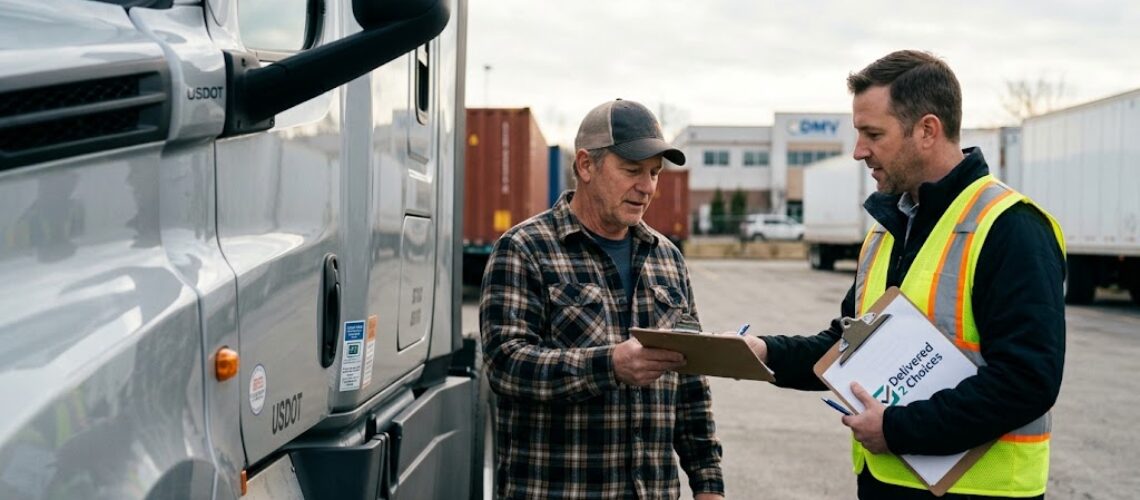

Federal transportation oversight has entered a strict enforcement cycle. Joint interagency task forces involving the FMCSA, the Department of Justice, and the Department of Homeland Security are dismantling fraudulent CDL training mills. They are purging thousands of non-compliant providers from the Training Provider Registry. They are also strictly enforcing non-domiciled CDL guidelines.
For professional drivers, these crackdowns mean that routine driver record reviews and state audits uncover hidden compliance gaps. If an audit flags credentialing discrepancies, training fraud, or underlying safety violations, drivers face unexpected license downgrades. These issues create a direct path into the mandatory DOT Return-to-Duty process.
Table of Contents
ToggleQ&A: The Non-Domiciled CDL Crackdown & Fraud Enforcement
Q1: What is the FMCSA Non-Domiciled CDL Crackdown?
Answer: Following the FMCSA’s final rule published on February 13, 2026 (taking full effect on March 16, 2026), strict regulations restrict non-domiciled CDL and Return-to-Duty requirements exclusively to drivers holding specific employment-based temporary work visas, including H-2A, H-2B, and E-2 visas. Standalone Employment Authorization Documents no longer qualify drivers for a non-domiciled CDL. State Driver Licensing Agencies must verify status through the SAVE system. Any changes in immigration status or eligibility trigger an automatic state downgrade or revocation.
Q2: What official federal resources and links track these enforcement actions?
Answer: Drivers can review official federal announcements and legal guidelines directly through government portals:
- Official rules and updates on non-domiciled CDL requirements: FMCSA Non-Domiciled CDL Rule FAQs
- Federal announcements on interagency enforcement sweeps and training school removals: U.S. Department of Justice Press Release on Trucking Fraud Enforcement
- Regulatory standards for state driver disqualifications: FMCSA State CDL Program Guidelines
Q3: How does a credential or training audit lead to a license downgrade?
Answer: Federal task forces audit third-party testing centers, training schools, and state databases. They cross-reference driver training certificates against active federal records. If a driver completed training through a purged or fraudulent provider, or if their non-domiciled documentation lapses, their license certification becomes invalid. This invalidation prompts an immediate administrative downgrade by the DMV.
Q4: Can a routine qualification review trigger a DOT Clearinghouse or drug testing issue?
Answer: Absolutely. State agencies and drivers conduct deep file reconciliations during enforcement sweeps. They frequently uncover unaddressed drug or alcohol violations, missed testing documentation, or unrecorded Clearinghouse flags. Any active safety-sensitive violation immediately pushes a driver into prohibited status. This status locks their profile and keeps their CDL downgraded.
The Segue: From Credential Audits to Road Readiness
The ongoing crackdown focuses primarily on licensing legitimacy, training provider verification, and administrative fraud. However, the fallout invariably exposes secondary compliance failures. When a driver’s credentials are frozen, audited, or downgraded due to regulatory non-compliance, any unaddressed safety or drug testing infraction surfaces immediately.
If your audit or Clearinghouse profile reveals a prohibited status, fixing your paperwork is not enough. You must complete the official federal Return-to-Duty process before you can clear your name and get back behind the wheel.
Step-by-Step Guide to the Return-to-Duty Process
- Step 1: Initial SAP Evaluation — Schedule and complete an in-depth evaluation with a qualified Substance Abuse Professional. This evaluation assesses your substance use history and maps out a personalized treatment or education plan.
- Step 2: Education or Treatment Completion — Successfully finish the specific program requirements prescribed by your Substance Abuse Professional.
- Step 3: Follow-Up SAP Evaluation — Attend a face-to-face follow-up evaluation with your Substance Abuse Professional. This meeting confirms your compliance and determines if you are ready for testing.
- Step 4: Return-to-Duty Testing — Take a directly observed DOT return-to-duty drug and alcohol test. A negative result is legally required before performing any safety-sensitive functions.
- Step 5: Clearinghouse & DMV Reinstatement — Pass your return-to-duty test and ensure your negative result is properly logged to clear your prohibited status. For detailed official guidance on how this fifth step functions for independent drivers, view the Official FMCSA Clearinghouse Step 5 FAQ Guidelines. To see how our driver-focused C/TPA support helps you complete this final milestone and get the DMV off your back, visit our C/TPA Services and Step 5 Clearinghouse Guidance.
Get Your CDL Reinstated & Clear Your Record Today
Navigating federal credentialing crackdowns, Clearinghouse locks, and Substance Abuse Professional requirements can feel overwhelming when you manage them alone. If you are an independent driver looking to clear Step 5, get the DMV off your back, and reinstate your commercial driving privileges without depending on a motor fleet, Delivered 2 Choices is built exclusively for you.
- Clear an FMCSA Violation: Visit our Clear FMCSA Violation California page to start your individual reinstatement process.
- Call or Text Us Directly: Speak with our driver compliance team right now at 916-399-3047.