

Table of Contents
TogglePublished Date: December 9, 2024
Last Updated: October 28, 2026
The Department of Transportation (DOT) and the state Department of Motor Vehicles (DMV) play pivotal, interconnected roles in the Return-to-Duty (RTD) process for commercial drivers. If you are a Commercial Driver’s License (CDL) or Commercial Learner’s Permit (CLP) holder who has a drug or alcohol testing violation in the FMCSA Clearinghouse, navigating the pathway back to work requires a clear understanding of federal regulations and state-level licensing actions.
At Delivered 2 Choices, we specialize in guiding CDL drivers through every phase of the Return-to-Duty process with expert Substance Abuse Professional (SAP) evaluations, helping you regain compliance, clear licensing restrictions, and get back on the road safely and legally.
Understanding the Federal Return-to-Duty Process
The Return-to-Duty process is a strictly regulated, step-by-step program mandated by 49 CFR Part 40. It ensures that safety-sensitive transportation employees address substance use concerns or refusals to test before returning to safety-sensitive functions. The key milestones include:
1. Initial Assessment by a Substance Abuse Professional (SAP)
Following a drug or alcohol violation, the driver must select a qualified SAP in the FMCSA Clearinghouse. The SAP conducts a thorough clinical evaluation to determine the appropriate course of education, treatment, or clinical intervention.
2. Completion of Recommended Education or Treatment
The driver must complete all education classes or treatment programs prescribed by the SAP. Compliance is closely monitored, and progress is documented prior to scheduling the follow-up evaluation.
3. Follow-Up Evaluation
Once education or treatment is completed, the SAP conducts a secondary evaluation to confirm that the driver has successfully complied with all recommendations.
4. Return-to-Duty Testing
After the SAP submits the determination of compliance in the Clearinghouse (step 4), a current or prospective employer will order a DOT Return-to-Duty drug and/or alcohol test. The driver must receive a verified negative test result before performing any safety-sensitive duties.
5. Follow-Up Testing Plan
The SAP establishes a mandatory follow-up testing plan consisting of at least six unannounced drug/alcohol tests within the first 12 months after returning to duty. This testing schedule can extend for up to 60 months (5 years), managed directly by the employer or a Consortium/Third-Party Administrator (C/TPA).
For a visual breakdown of these milestones, review the official FMCSA Return-to-Duty Process Overview.
DOT vs. DMV: Key Differences & Federal Downgrade Rules
Understanding the distinction between federal DOT mandates and state DMV enforcement is crucial for keeping your CDL active:
- Department of Transportation (DOT / FMCSA): Oversees federal safety regulations, driver qualification standards, and the FMCSA Drug and Alcohol Clearinghouse database.
- Department of Motor Vehicles (DMV): Governs state-level driver licensing, records, endorsements, suspensions, and CDL reinstatements.
Federal CDL Downgrade Mandate
Under federal rules, state driver licensing agencies (SDLAs) are required to downgrade a driver’s commercial driving privileges upon receiving notification of a prohibited Clearinghouse status. If a driver remains in a “Prohibited” status due to an unaddressed drug or alcohol violation, the state DMV will remove the CDL endorsement from their record, downgrading them to a non-commercial driver’s license.
To avoid or resolve a state CDL downgrade, drivers must successfully complete the Return-to-Duty process in the Clearinghouse (Step 5). You can learn more about federal downgrade requirements directly at the FMCSA Clearinghouse CDL Downgrades Information Page.
Clearinghouse Step 5: Clearing Your CDL Status at the DMV
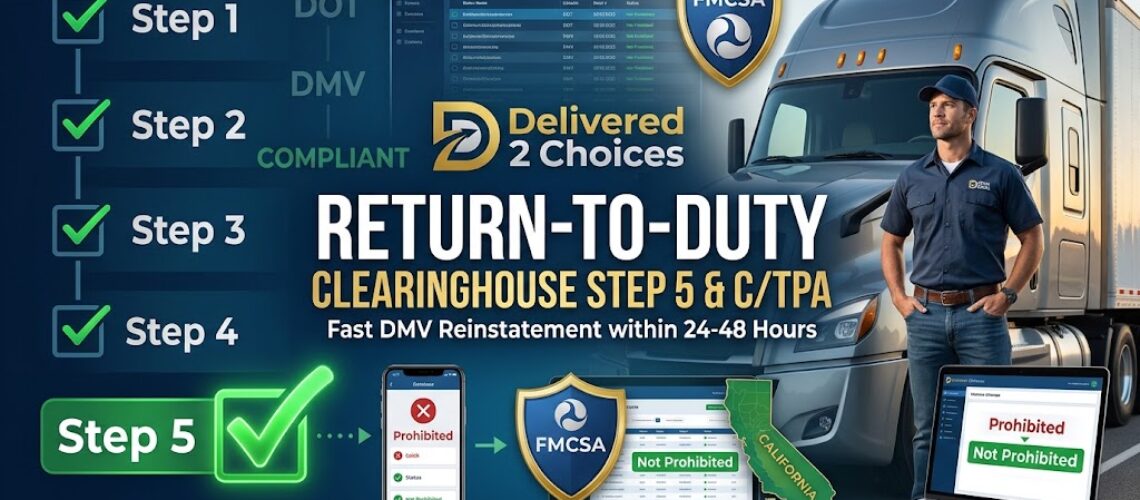
Reaching Step 5 in the FMCSA Clearinghouse—where your employer or C/TPA records a negative Return-to-Duty test result—is the critical milestone that removes your “Prohibited” driver status.
How Step 5 Restores Your Driving Eligibility
- Clearinghouse Status Change: Once your negative RTD test is recorded, your Clearinghouse status changes from “Prohibited” to “Not Prohibited.”
- State SDLA Notification: State DMVs query the Clearinghouse electronic database. Once Step 5 is verified, state licensing authorities update their records to remove the commercial downgrade or suspension status usually within 24-48 hours.
- CDL Renewal & License Protection: Having Step 5 recorded is essential when renewing your commercial license or applying for a new motor carrier position, ensuring your DMV record reflects full compliance.
Expedited C/TPA Services at Delivered 2 Choices
For driver-employees and owner-operators needing immediate assistance in reporting Step 5, Delivered 2 Choices provides designated C/TPA administrative services. Our team assists in expediting the official entry of your negative RTD test result into the Clearinghouse database immediately upon receipt. Fast-tracking this entry helps remove DMV commercial license holds swiftly so you can get back on the job without unnecessary delay.
Key Steps to Reinstating Your CDL Record
- Complete All SAP Requirements: Complete your SAP initial evaluation, prescribed treatment or education, and follow-up evaluation.
- Submit to Return-to-Duty Testing: Pass a DOT drug or alcohol test requested by your employer or C/TPA.
- Verify Step 5 Completion: Ensure your negative RTD test result is logged in your FMCSA Clearinghouse dashboard (reflecting checkmark #5).
- Pay DMV Reinstatement Fees: Contact your local state DMV to clear any administrative holds and pay applicable license reinstatement fees.
- Provide Proof of Compliance: Keep copies of your SAP completion letters and a screenshot of your updated “Not Prohibited” Clearinghouse status for your driver qualification file and state licensing office.
Why the Return-to-Duty Process Matters
The Return-to-Duty process protects highway safety while providing drivers with a clear, lawful pathway back to their careers. Neglecting a violation can result in license downgrades, employment disqualification, and legal penalties for operating commercial motor vehicles without proper credentials.
If you are operating in the state of California, navigating state-specific DMV regulations alongside federal mandates requires localized expertise. Learn more about completing our remote RTD full process throughout California to explore step-by-step clinical evaluations and state compliance support.
Frequently Asked Questions (FAQs)
1. What is a DOT Return-to-Duty test?
A DOT Return-to-Duty test is a directly observed drug and/or alcohol test required after completing the SAP education or treatment program. A verified negative result is legally required before a driver can perform any safety-sensitive duties.
2. Can I drive a CMV while in the Return-to-Duty process?
No. Operating a commercial motor vehicle while listed as “Prohibited” in the Clearinghouse or while under a state DMV CDL downgrade is a federal violation subject to severe fines and extended suspensions.
3. How long does the Return-to-Duty process take?
The timeline depends on individual circumstances, including the level of education or treatment recommended by the SAP, clinical program availability, and driver participation. The process can range from a few days to several weeks.
4. How does Step 5 affect my CDL renewal at the DMV?
When your CDL is up for renewal, the state DMV checks the FMCSA Clearinghouse. If Step 5 is not completed, your renewal will be denied or downgraded. Completing Step 5 ensures your commercial driving privilege remains intact.
5. Do owner-operators need a C/TPA for Return-to-Duty testing?
Yes. Under FMCSA regulations, owner-operators cannot order or report their own Return-to-Duty tests in the Clearinghouse. They must work with an authorized Consortium/Third-Party Administrator (C/TPA) to manage testing and log Step 5 results.
Call to Action
Navigating DOT and DMV requirements does not have to stall your driving career. At Delivered 2 Choices, we provide fast, confidential, and fully compliant SAP evaluations and C/TPA reporting services to help you clear your record quickly.
Have questions or ready to schedule your evaluation? Text us directly or call us at 916-399-3047 to speak with a DOT-qualified SAP representative today!