
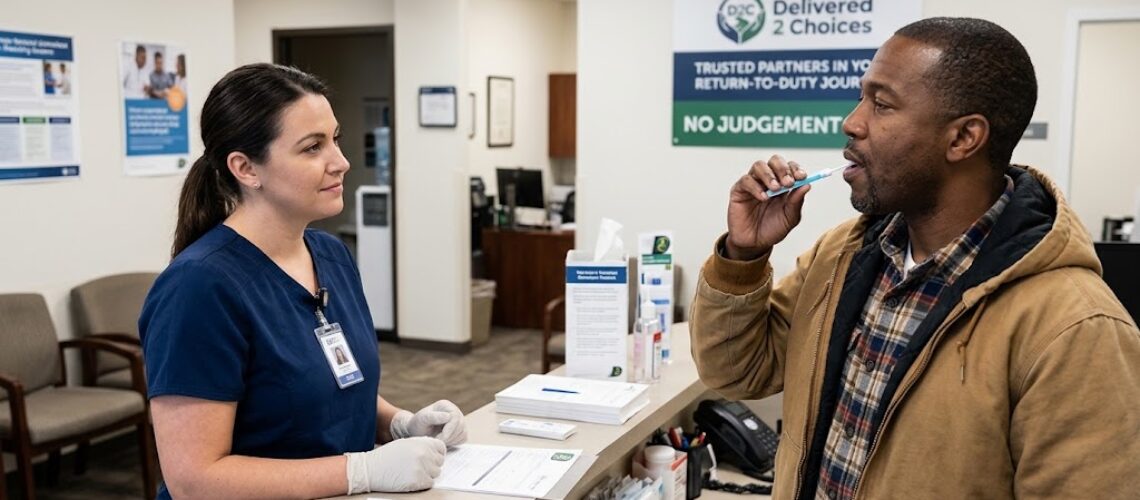

Managing the final steps of a drug testing requirement has historically involved an excessive amount of friction. This friction affects Consortium/Third-Party Administrators (C/TPAs) and commercial drivers alike. If you manage Step 5 testing, you are likely all too familiar with the logistical headaches of traditional urine drug screens.
Table of Contents
ToggleThe Old Logistics Nightmare: Same-Sex Observers and Automated Phone Walls
Under traditional federal urine testing guidelines, ensuring strict compliance meant coordinating precise details. Specifically, administrators had to verify the gender of the collection site staff. As a C/TPA managing Step 5 processes, standard protocol often required calling testing sites beforehand. The goal was to confirm whether a male technician was physically present and available to observe.
Unfortunately, modern technology frequently worked against this administrative necessity. Reaching a live person at a regional testing center through automated phone trees and endless loops of voice prompts became nearly impossible. Consequently, this communication barrier resulted in unnecessary, wasted trips to the lab. The driver would arrive, only to discover on-site that a same-sex observer was unavailable. This miscommunication forced frustrating rescheduling loops, delayed compliance windows, and left commercial drivers stranded on the sidelines.
Furthermore, traditional urine collections carried the notorious hurdle of “shy bladder” syndrome. This physiological freeze response prevents individuals from providing a specimen under pressure, frequently triggering unnecessary delays or accidental refusals.
A Welcome Shift: Embracing Oral Fluid Testing Protocols
On October 6, 2026, the Food and Drug Administration (FDA) issued a landmark final order eliminating the 510(k) premarket notification obligation for clinical toxicology test systems deployed across federal drug testing programs.
The regulatory landscape is shifting to resolve these exact pain points. Modern updates, such as the framework outlined in Federal Register Docket 2026-20448, help clear the path toward more flexible testing alternatives.
By integrating oral fluid swab testing into standard protocols where available, the industry is moving past legacy bottlenecks. Oral fluid testing inherently eliminates the logistical nightmare of tracking down same-sex observer technicians. Furthermore, it completely bypasses the anxiety and operational stall of shy bladder scenarios. For C/TPAs and employers, requesting oral fluid collections simplifies scheduling, reduces facility turnaround times, and cuts down on abandoned testing appointments.
Transforming Facility Turnaround and Chain of Custody
Beyond solving observer tracking and shy bladder issues, widespread adoption of oral fluid testing fundamentally alters daily operations at collection facilities.
In a traditional urine collection setup, lengthy specimen processing and temperature monitoring requirements cause severe bottlenecks. Meanwhile, oral fluid collections streamline the entire chain of custody. Because the sample is collected directly in front of the collector using a secure, visible device, the window for handling errors shrinks dramatically. Facility staff spend less time managing collection room security, and drivers spend less time waiting. For C/TPAs orchestrating tight Return-to-Duty timelines, this efficiency translates directly to faster clearances and fewer administrative headaches.
Integrating the Return-to-Duty (RTD) Process in California
For drivers navigating a violation, passing the test is only one piece of a structured regulatory puzzle. Transitioning back into safety-sensitive roles requires a precise sequence of events managed under federal guidelines. To understand the underlying mechanisms governing how tests are processed, it helps to examine the science of RTD drug testing.
Once a violation occurs, drivers cannot simply jump back behind the wheel. In California and across the nation, getting back to work legally requires navigating a multi-step compliance roadmap. You can review a comprehensive breakdown of this path via DOT qualified SAP evaluation in California.
The journey typically follows this structured trajectory:
- Initial Evaluation: Meeting with a qualified Substance Abuse Professional (SAP) for an initial clinical assessment.
- Education and Treatment: Completing the prescribed counseling, education, or treatment plan mandated by the SAP.
- Follow-Up Evaluation: Undergoing a follow-up evaluation with the SAP to determine if compliance has been successfully met.
- The Return-to-Duty Test (Step 5): Completing an appropriately administered RTD drug test with a negative result.
Minimizing Delays for Employers and Fleets
For fleet managers and C/TPAs, cutting down turnaround time on a Return-to-Duty test means getting revenue-generating assets back on the highway faster. Every day a driver sits waiting for an observer schedule to open up or a retest to clear represents a hit to operational efficiency. By prioritizing oral fluid options whenever collection sites support them, administrators can systematically bypass these legacy roadblocks, protect their compliance schedules, and keep commercial transportation moving forward smoothly.
Moving Forward
Streamlining compliance means leveraging every available regulatory update to minimize administrative downtime. Therefore, the next time you coordinate a testing appointment, remember to ask the testing site for oral fluid swab testing options if available.
If you need a SAP to move through the RTD process, TEXT or call 916-399-3047.